
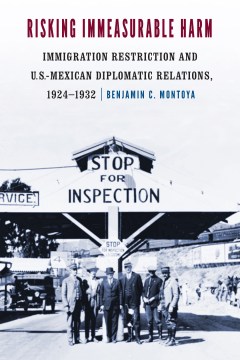
The debate over restricting the number of Mexican immigrants to the United States began early in the twentieth century, a time when U.S.-Mexican relations were still tenuous following the Mexican Revolution and when heated conflicts over mineral rights, primarily oil, were raging between the two nations. Though Mexico had economic reasons for curbing emigration, the racist tone of the quota debate taking place in the United States offended Mexicans’ national pride and played a large part in obstructing mutual support for immigration restriction between the United States and Mexico.
Risking Immeasurable Harm, my first book, explains how the prospect of immigration restriction affects diplomatic relations by analyzing U.S. efforts to place a quota on immigration from Mexico during the late 1920s and early 1930s. The controversial quota raised important questions about how domestic immigration policy debates had international consequences, primarily how the racist justifications for immigration restriction threatened to undermine U.S. relations with Mexico.
This work follows the quota debate from its origin in 1924, spurred by the passage of the Immigration Act, to its conclusion in 1932. I examine congressional policy debate and the U.S. State Department’s steady opposition to the quota scheme. Despite the concerns of American diplomats, in 1930 the Senate passed the Harris Bill, which singled out Mexico among all other Latin American nations for immigration restriction. The lingering effects of the quota debates continued to strain diplomatic relations between the United States and Mexico beyond the Great Depression.
Relevant to current debates about immigration and the role of restrictions in inter-American diplomacy, Risking Immeasurable Harm demonstrates the correlation of immigration restriction and diplomacy, the ways racism can affect diplomatic relations, and how domestic immigration policy can have international consequences.
Risking Immeasurable Harm is available for purchase in various formats, most notably paperback.

My second book, A Diplomatic History of US Immigration during the 20th Century: Policy, Law, and National Identity, with Bloomsbury Academic Publishing, shows how U.S. efforts to curb, block, and monitor the entry of Chinese, Japanese, Mexicans, Cubans, Central Americans, and Vietnamese from the early twentieth century to the early twenty-first century complemented and contradicted U.S. foreign policy objectives. This case-study approach offers critical insights into the similar and dissimilar challenges different immigrant groups faced as they tried to enter the United States. It also shows how changing historical contexts influenced, shaped, and re-shaped U.S. leaders’ approach to the immigration issue. Finally, the book informs students and instructors as they discuss in their classrooms how the ongoing debate over American identity formation, state building, and power projection influences how Americans view foreigners, and how those responses take form both in immigration law and foreign policy.
A Diplomatic History of US Immigration during the 20th Century is available for order in the United States and the United Kingdom.
 Benjamin C. Montoya